

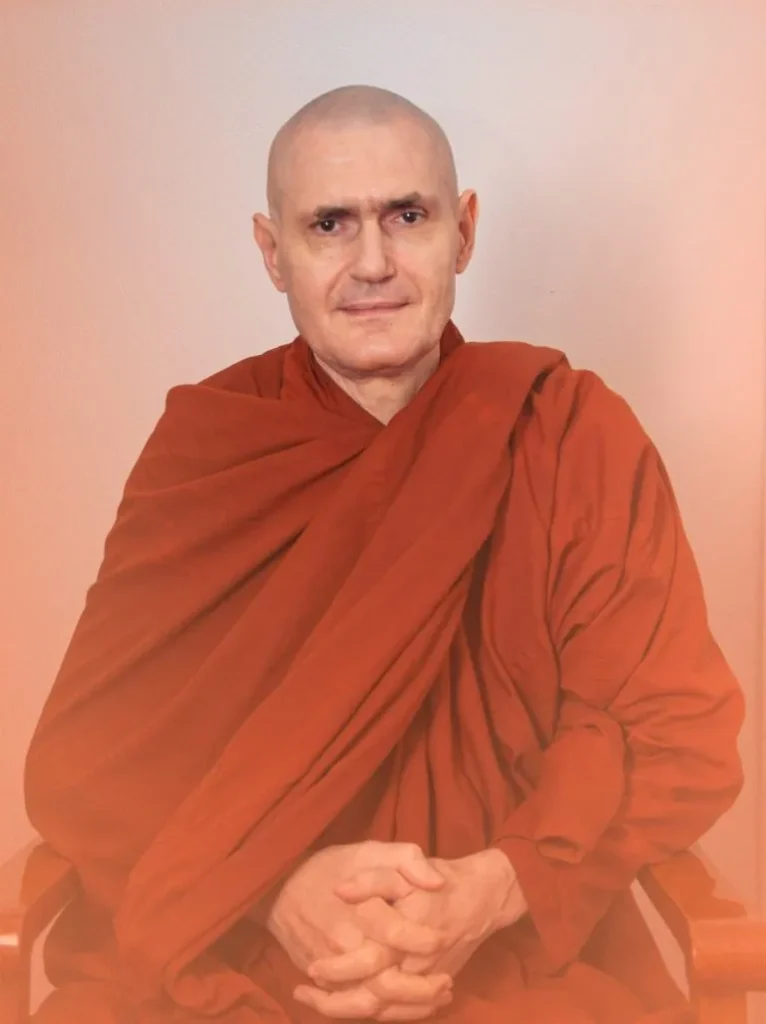
Bhante Nyānadassana
The Greek-born Buddhist monk Nyānadassana or Ñāṇadassana (Ioannis Tselios) has been a monk in the ancient Buddhist Theravāda forest tradition for over 40 years and lives mainly in Sri Lanka.
Born in 1959 in Serres, Greece, he finished high school in Thessaloniki and studied sociology at Goethe University in Frankfurt, Germany. In 1981, at the age of 22, a trip to India became a turning point in his life when, looking at a tourist brochure, he read these memorable words of the Buddha:
“This is my last birth. I have crossed the ocean of existence.”
Reflecting deeply on these words and determined to learn more about the Buddha and his Teaching, he visited Kusināra, the place where the Buddha attained his final rest in Nibbāna (Parinibbāna). Here, under the guidance of an Indian Buddhist elder monk, the director of the Kusināra Museum, Ioannis Tselios, not only practised meditation but also studied Buddhism. With increased interest, he decided to seek the original and authentic teachings of Buddha, eventually arriving in Sri Lanka.
In 1982, at the age of 23, he was ordained as a novice by his preceptor (upajjhāya), Venerable Kaḍavedduve Shrī Jinavaṃsa Mahāthera, a state-recognised scholar (rājakīya paṇḍita). He entered the monastic life for full-time study and practice. For four years, he trained under the guidance of Venerable Mātara Ñāṇārāma Mahāthera, a state-recognised scholar (rājakīya paṇḍita) and renowned meditation teacher at the Nissaraṇa Vanaya Monastery in Mītirigala.
In 1986, he received higher ordination (upasampadā) from his preceptor, Venerable Kaḍavedduve Shrī Jinavaṃsa Mahāthera. He then studied the ancient Indian language of Pāḷi and the Buddhist Triple Canon (Tipiṭaka), as well as its Commentaries and Subcommentaries, under three learned Elders (Mahāthera) at the Gnānārāma Dharmāyatanaya Monastery in Mītirigala, where he stayed for 16 years.
In 1997, after written and oral examinations, he received the title of Vinayācariya (Teacher of Monastic Discipline). Inspired by his teacher, he began teaching the Pāḷi language and the Tipiṭaka for several years. From 2003 to 2007, he practised meditation in Myanmar (Burma), and then returned to Sri Lanka. He has been repeatedly invited by Buddhist centres in Singapore, Indonesia, Malaysia, and Taiwan to deliver Dhamma talks and meditation classes. An experienced speaker, he has given numerous lectures in English, Sinhalese, and Greek.
His Most Important Scholarly Work for the Monastic Community
In 2002, Venerable Ñāṇadassana published When Is Dawn (aruṇa)? When Is Dawnrise (aruṇuggamana)?, a groundbreaking research work that took more than five years to complete. The book was officially approved on 25th August 2002 by the Executive Saṅgha Committee of the Shri Kalyāṇī Yogāshrama Sansthāva Forest Monks in Sri Lanka.
This scholarly work addresses a critical issue in Vinaya practice: the precise determination of aruṇuggamana (dawnrise), which serves as the actual offence criterion (āpatti-aṅga) for many monastic rules. The research clarifies a widespread confusion between aruṇa (dawn, when darkness still prevails) and aruṇuggamana (dawnrise, when natural light appears and the night becomes light). As Venerable Handurumulle Sirikusala Thero, a Vinaya Teacher of the Sri Lanka Rāmañña Mahānikāya, wrote: “The publication of this book is to be highly regarded as very timely on a matter that was incomprehensible to many knowledgeable laypeople and monks alike.”
The research methodology combined the study of canonical and post-canonical Pāḷi texts with empirical observation, including direct observation of the sky at multiple locations in Sri Lanka (the south-eastern coast, the high-altitude region of Adam’s Peak, and the north-eastern coast at Trincomalee). The empirical data were verified by scientists at the Department of Meteorology in Colombo, Sri Lanka.
The work establishes that dawnrise marks the end of the entire night (darkness) and the beginning of the day (light), occurring approximately 30 minutes before sunrise in Sri Lanka. At this moment, the four quarters become white (odāta-disā), the night becomes light (ratti vibhāyati), and there is sufficient natural visibility for work and travel—criteria essential for monks observing rules concerning proper eating times (kāla-bhojana), the three-robe requirement (tecīvarika), the rains-retreat (vassa), and monastic probation procedures (parivāsa and mānatta).
The book includes photographs, scientific charts, and tables correlating the Pāḷi textual criteria with modern astronomical definitions of civil, nautical, and astronomical twilight. Venerable Kumāra Bhikkhu of Malaysia noted that “Ven. Ñāṇadassana’s findings are the result of extensive and detailed study… firmly based on sound investigation.”
The practical impact of this research has been significant: many forest monasteries in Sri Lanka and throughout the Theravāda world now operate in accordance with the findings presented in this work, adjusting their daily schedules and Vinaya observances to align with the textually accurate and scientifically verified understanding of dawnrise.
His Years in Greece
In 2019, following an invitation from Michail Xynos, the founder and director of the Athens Theravada Centre, Venerable Ñāṇadassana arrived in Greece, where he resided for six years. During this period, he conducted meditation seminars, extensive courses in Buddhist philosophy and psychology, and produced thousands of hours of video teachings in Greek and English. His teachings covered a wide range of subjects, including Ānāpānasati (mindfulness of breathing), Mettā (meditation on friendliness), Kasiṇa meditation, the Four Elements, Vipassanā (insight meditation), the analysis of matter and mind as the root of our existence, and numerous Dhamma talks. His teachings attracted a following of more than 21,000 people in Greece.
Literary Works from His Time in Greece
During his years in Greece, Venerable Ñāṇadassana authored and translated several important works:
- Dhammapada – translated directly from Pāli into Greek, making this foundational Buddhist text accessible to Greek readers in an authentic rendering from the original language
- Meditation: Liberation or Attachment – authored in English and Greek
- The Historical Buddha – authored in English and Greek
- Karaṇīya Mettā – authored in Greek
- Buddhism without Misinterpretations – authored in Greek
- What the Buddha Taught by Ven. Walpola Rahula – translated into Greek
Contribution to the PaliVerse Project
His profound knowledge and insights were the foundation of the PaliVerse project, an ambitious AI-powered initiative to translate the complete Pāli Canon into multiple languages. His contributions to the project have been substantial: he compiled a glossary of around 5,000 essential Pāli terms with their English and Greek equivalents. He edited the English and Greek titles and subtitles of the Tipiṭaka. These scholarly resources are now used to guide the PaliVerse AI in producing accurate and consistent translations into English and Greek, ensuring that the project benefits from his decades of study and expertise in Pāli and the Buddhist canonical texts. He also emphasised the critical importance of the commentarial literature (Aṭṭhakathā and Ṭīkā) for both the translation and the correct interpretation of canonical passages—a principle rooted in the traditional Theravāda approach to textual study that he learned during his sixteen years at the Gnānārāma Dharmāyatanaya Monastery—and this principle was accordingly incorporated into the AI translation process.
From July 2025, Venerable Ñāṇadassana returned to Sri Lanka, and he is actively involved in improving the English translations of PaliVerse, focusing on the technical terminology.
He is the author and translator of approximately twenty Buddhist books in German, English, Sinhalese (the official language of Sri Lanka), Pāli, and Greek.
His monastic name, Ñāṇa-dassana, means ‘Knowing and Seeing,’ and he is considered the Most Senior monk (Mahāthera) in his tradition.